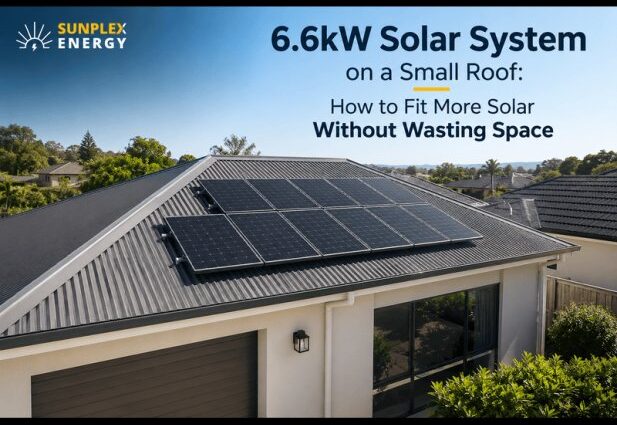
For many Australian homeowners, a 6.6kW solar system is an attractive choice because it can provide substantial renewable energy without requiring an oversized rooftop. However, fitting enough panels onto a small or complicated roof can be challenging.
Roof orientation, panel dimensions, shading, access pathways, ventilation requirements and local installation standards can all affect how many panels can realistically be installed.
The good news is that a small roof does not automatically mean you need to give up on solar. With careful planning and the right equipment, homeowners can often make better use of their available roof area.
What Is a 6.6kW Solar System?
A 6.6kW solar system refers to the combined DC capacity of the solar panels installed on a property. The actual number of panels depends on the wattage of the individual panels.
For example:
- 16 × 410W panels = 6.56kW
- 15 × 440W panels = 6.60kW
- 14 × 470W panels = 6.58kW
- 13 × 500W panels = 6.50kW
This means homeowners do not necessarily need a fixed number of panels to achieve approximately 6.6kW.
For a residential solar system, higher-wattage panels can sometimes help achieve the desired capacity while using less roof space.
Why Is a 6.6kW System Challenging on a Small Roof?
A roof may appear large from the ground but have considerably less usable space than expected.
Several factors can reduce the available installation area:
Roof Orientation
Not every section of a roof receives the same amount of sunlight. North-facing areas are traditionally attractive in Australia, but east- and west-facing roof sections can also be useful depending on household electricity consumption.
Roof Obstructions
Skylights, chimneys, vents, satellite dishes and roof structures can interrupt panel layouts.
Shading
Trees, neighbouring buildings and nearby structures can create shadows across the roof. Even partial shading can affect solar generation depending on the system design.
Roof Shape
Small roofs with multiple angles or separate sections can be harder to utilise efficiently than a large, simple rectangular roof.
Required Access and Installation Clearances
Installers also need to consider safety, maintenance access and applicable Australian installation requirements. Therefore, the entire roof should not be treated as available panel space.
How Can You Fit More Solar on a Small Roof?
1. Choose Higher-Wattage Solar Panels
One of the simplest ways to maximise limited roof space is to consider modern high-wattage panels.
Instead of automatically choosing more panels with lower individual output, a homeowner may be able to achieve a similar system capacity with fewer, higher-output panels.
For example, comparing:
16 × 410W = 6.56kW
with:
14 × 470W = 6.58kW
shows how panel wattage can influence the physical layout.
However, wattage should not be the only selection factor. Panel dimensions, efficiency, warranty, temperature performance and product quality also matter.
2. Measure the Roof Before Choosing the System
Don’t start with the assumption that every 6.6kW solar system will require the same roof area.
A professional installer should assess:
- Roof dimensions
- Roof pitch
- Orientation
- Shading
- Obstructions
- Panel dimensions
- Access requirements
- Inverter location
- Cable routing
This creates a more realistic picture of what can actually fit.
3. Consider Multiple Roof Orientations
If the main roof section cannot accommodate enough panels, another suitable roof section may provide additional space.
For example, a combination of north- and west-facing panels could potentially help a household spread generation across different parts of the day.
The best configuration depends on the property’s location, roof design and electricity consumption profile.
4. Use an Efficient System Design
A good system is not simply about putting as many panels as possible on the roof.
The inverter, panel configuration and electrical design need to work together.
For roofs with different orientations or shading conditions, installers may consider technologies such as module-level power electronics or optimisers, where appropriate.
These technologies can provide more flexibility in certain installations, although they are not automatically necessary for every home.
Can a 6.6kW Solar System Work With a Solar Battery?
Yes. A solar battery system can complement a 6.6kW solar installation, particularly when a household uses significant electricity after sunset.
Without a battery, excess solar generation during the day may be exported to the electricity grid, subject to the property’s connection and export arrangements.
With a battery, suitable surplus generation can instead be stored for later use.
This can be particularly useful for households that:
- Use air conditioning in the evening
- Have high evening electricity consumption
- Want to increase solar self-consumption
- Are considering an electric vehicle
- Want greater control over when stored solar energy is used
However, battery sizing should be based on actual electricity consumption rather than simply matching the battery to the solar system’s 6.6kW rating.
What If You Cannot Fit a Full 6.6kW System?
Don’t force a system onto a roof simply to reach a specific number.
If roof limitations mean a complete 6.6kW installation isn’t practical, a smaller system with a better layout may deliver better real-world performance than a poorly positioned larger system.
You could also consider future expansion if the inverter, roof space and electrical design allow it.
This is why a site assessment is important before making a final decision.
Small Roof Doesn’t Mean Small Solar Potential
A limited roof area can make solar installation more complicated, but it doesn’t necessarily prevent homeowners from installing a high-capacity system.
For a 6.6kW solar system, the key is to optimise the available space rather than simply filling every possible section of the roof.
Higher-wattage panels, careful roof assessment, appropriate orientation and professional system design can help homeowners make better use of limited space.
For households considering a residential solar system, adding a solar battery system may also provide another way to maximise the value of the energy their panels generate.
Ultimately, the right system depends on the individual property. A qualified solar professional should assess the roof, electricity usage, shading and electrical requirements before recommending the final design.


Comments are closed, but trackbacks and pingbacks are open.