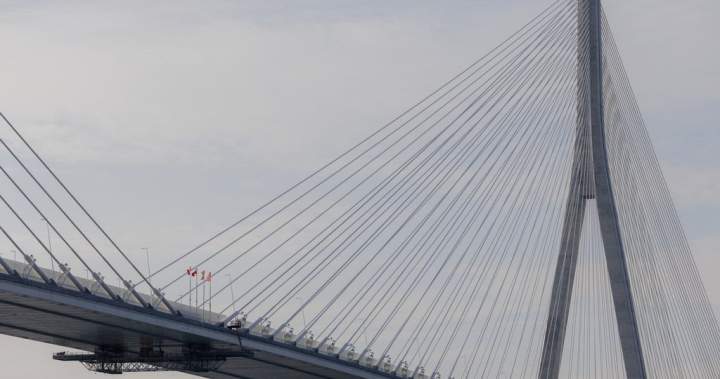
Canadian manufacturers are already losing orders from the US as businesses brace for President Donald Trump’s latest tariff threat, even as the Gordie Howe International Bridge prepares to open on Monday.
William Pellerin, an international trade lawyer, told Global News on Saturday that some Canadian companies reported already feeling the impact of Trump’s proposed 50 percent tariff before it took effect on Aug. 19.
“We have spoken to a large number of clients who, due to the threat of 50 percent tariffs that will come into effect next month, have lost massive orders from US customers,” Pellerin said.
Trump threatened to impose tariffs on certain Canadian goods last Sunday, along with another 10 per cent tariff that would be imposed on goods outside the Canada-US-Mexico Agreement.
Pellerin said proposed tariffs of 50 per cent would make many Canadian products too expensive to compete in the US, especially in sectors such as furniture and electronics.
“Tariffs of 50 percent really make Canadian businesses uncompetitive in the United States,” he said.
He said the uncertainty alone was affecting entrepreneurs, with American buyers pulling back due to concerns that they would face much higher costs.

Get daily National news
Get Canada’s daily news stories delivered to your inbox so you never miss the day’s top stories.
“We’ve seen some layoffs by Canadian manufacturers just because of the threat,” Pellerin said.
Furniture and wood products may be the sectors most impacted, as manufacturers in small communities rely heavily on exports to the United States.
“A lot of these furniture manufacturers often have two or three hundred jobs in a small town somewhere,” he said. “It’s going to shut down entire cities in Canada. So we’re hearing the word ‘disaster’ from some of our clients.”
The latest tariff threat is part of an escalating trade dispute between the two countries following Canada’s retaliation against previous US tariffs.
Pellerin said Ottawa’s top priority is getting back to the negotiating table before the tariffs take effect, and also moving ahead with legislation aimed at strengthening forced labor regulations in Canada.
The trade uncertainty comes as the Gordie Howe International Bridge prepares to open on Monday, creating another major commercial crossing between Canada and the United States.
Currently, the agreement states that Canada will share 50 percent of net toll revenues with the U.S. for the first 15 years of construction of the bridge, and the money will go toward economic development on the American side of the border, according to the Canadian government.
Trump’s post on his Truth Social platform appeared last Sunday to mark the opening of a new bridge to Detroit, which was officially designated on Monday.
“Canada did not invite the United States to attend the opening of the conference, and that is fine, considering that they pay huge tariffs to the United States,” Trump wrote.
“The original Bridge Agreement, poorly negotiated by the previous administration, is no longer valid. We changed the terms of the Agreement so that the United States now gets 50% of the Profits.”
Despite recent tensions, Housing and Infrastructure Minister Gregory Robertson said the two countries continued to have a strong working relationship.
“There were times when we had to pick ourselves up a little bit… but we came out of this stronger and we have a beautiful bridge here that will serve Windsor in Detroit, Canada and the U.S. for generations to come.”
© 2026 Global News, a division of Corus Entertainment Inc.


Comments are closed, but trackbacks and pingbacks are open.