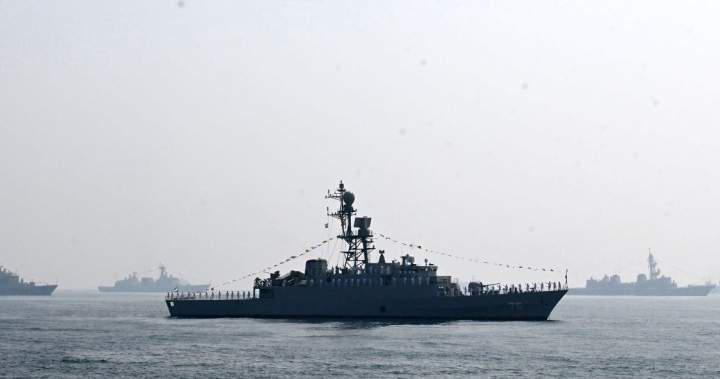
The United States (US) sank an Iranian warship in international waters, Defense Minister Pete Hegseth said on Wednesday, as the US stepped up bombing of Iranian security forces and other symbols of power with Israel. Tehran vowed to completely destroy the Middle East’s military and economic infrastructure – signaling the war is far from over and could spread further.
The tempo of attacks on Iran was so intense that state television announced mourning ceremonies for Iran’s Supreme Leader Ayatollah Ali Khamenei, who was killed in the conflict, would be postponed. Millions of people attended the funeral of his predecessor Ayatollah Ruhollah Khomeini in 1989.
In addition to attacking Tehran on the fifth day of the conflict, Israel also attacked the Iran-backed Hezbollah militant group in Lebanon, while Iran shelled Bahrain, Kuwait and Israel. As the conflict escalated, Türkiye said NATO defenses intercepted ballistic missiles launched from Iran before they entered Turkish airspace.
The war has killed more than 1,000 people in Iran and dozens in Lebanon, as well as disrupting global oil and gas supplies, disrupting international shipping and stranding hundreds of thousands of travelers in the Middle East.

Both sides continued their attacks incessantly
Defense Secretary Pete Hegseth said a US submarine torpedo sank an Iranian warship. He did not name the ship, but previously an Iranian warship sank off the coast of Sri Lanka.
In a Pentagon briefing, Hegseth said that Tuesday night’s attack on an Iranian warship was the first attack on an enemy since World War II.
“An American submarine sank an Iranian warship that was considered safe in international waters,” Hegseth said. “Instead, the ship was sunk by a torpedo.”
Sri Lankan authorities said 32 people were rescued from the Iranian boat and others died.
Israel said it hit buildings linked to Iran’s Basij, the Revolutionary Guard paramilitary force that carried out a bloody crackdown on protesters in January that killed thousands and led to tens of thousands being detained in the country.
The Israeli military also said it attacked buildings linked to Iran’s internal security command, which has also suppressed demonstrations in the past. This attack also hit cities near Beirut.

Get daily National news
Get the day’s latest news, politics, economics and headlines, delivered to your inbox once a day.
Israel and the US say they want to see Iranians overthrow the country’s theocracy, and attacks on counter-protest forces are likely part of that effort.
Iranian state television showed the ruins of buildings in the center of the capital Tehran, and people interviewed said the attacks damaged their homes. Attacks were also reported in the Shiite holy city of Qom, targeting buildings associated with a panel of clerics who will choose Iran’s next supreme leader. Iranian media said the venue was empty at the time.
State TV began calling the conflict the “Ramadan war,” a reference to the ongoing Muslim holy month of fasting. However, the term also shows that leaders are trying to prepare society for a prolonged conflict.
Admiral Brad Cooper, the top US military commander in the Middle East, echoed similar sentiments, saying: “We’re just getting started.”
Cooper said American forces had damaged Iran’s air defenses and destroyed ballistic missiles, launchers and drones. Israeli military spokesman Brig. Gen. Effie Defrin said the damage had led to a reduction in launches from Iran.

However, explosions still echoed across Jerusalem’s skies on Wednesday, and the Israeli military said Iran had launched missiles into the country, while Hezbollah sent rockets.
Iran also launched attacks in the region, and air sirens sounded early Wednesday across Bahrain, home to the US Navy’s 5th Fleet.
At least 1,045 people have died in Iran, the country’s Foundation for Martyrs and Veterans Affairs said Wednesday. Eleven people in Israel have been killed. More than 50 people have been killed in Lebanon, according to the Health Ministry. Six US soldiers died.
People in Tehran are unsure what to do
A Tehran resident, who runs a clothing store, said he did not know how to protect himself from the bombing.


“It’s very difficult to decide what to do. If I leave the city, how will I earn money and survive?” said the man, who declined to be named for fear of retribution.
Energy supply in the crosshairs
Iran’s paramilitary Revolutionary Guard issued its most powerful threat ever.
“The crimes and deception that the United States continues to commit in the region will result in the complete destruction of the region’s military and economic infrastructure,” he said in a statement issued on Iranian state television.
When the Iranian attack disrupted the movement of tankers through the Strait of Hormuz, the narrow mouth of the Persian Gulf through which about a fifth of the world’s oil is shipped, the price of Brent crude hit US$84 a barrel, up more than 15 percent since the start of the conflict and the highest price since July 2024.
Global stock markets took a hit due to concerns that surging oil prices could weaken the world economy and weaken corporate profits.

Iran’s clerics are electing a new supreme leader
Iran’s leaders are pushing hard to replace Khamenei, who ruled the country for 37 years, and was killed on the first day of the attack.
This is the second time since the Islamic Revolution of 1979 that a new supreme leader has been elected.
Potential candidates range from hardliners committed to confrontation with the West to reformers seeking diplomatic engagement. Mojtaba Khamenei, Khamenei’s son, has long been considered one of them – despite the fact that he has never been elected or appointed to a government position.
In a sign that Iran’s leadership will only seek to consolidate its power as it faces its biggest crisis in decades, the judiciary chief on Wednesday warned that “those who collaborate with the enemy in any way will be considered enemies.”
Meanwhile, Israel’s Defense Minister threatened whoever Iran chooses to be the country’s next supreme leader.
“Any leader appointed by the Iranian terror regime to continue and lead plans to destroy Israel, to threaten the United States and the free world and the countries of the region, and to oppress the Iranian people – will be targeted for elimination,” wrote Israel Katz in X.
It is unclear how Washington will respond if a new leader like Khamenei is elected. US President Donald Trump said on Tuesday that “the worst case would be to do this, and then someone just as bad as the previous person would take over.”


Comments are closed, but trackbacks and pingbacks are open.