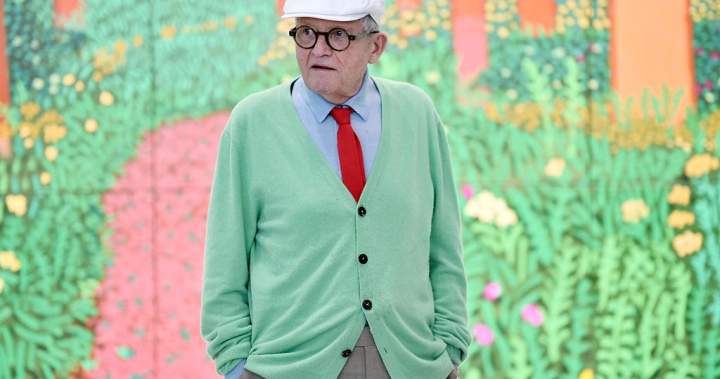
David Hockney, the renowned British artist whose sparkling pond paintings and colorful iPad drawings became an icon of contemporary art, has died, his publicist said Friday. He is 88 years old.
Over a seven-decade career, Hockney explored and reimagined classical portraiture, landscape painting, and pop art, working in painting, collage, photography, and digital drawing.
Hockney was born in the north of England but lived most of his life in Southern California, making the sun-drenched suburban landscape a central motif.
Later in life, he returned to Europe, finding new inspiration in the wooded hills of his native Yorkshire and the fields and trees of France’s Normandy region. One of the most popular and critically acclaimed British artists of his generation, his work sells for record prices at auction.
FILE: British artist David Hockney stands next to his painting ‘Studio Interior #14’ at the launch of his new exhibition ‘Paintings and Photography’ at the Annely Juda Fine Art Gallery on May 14, 2015, in London, England.
Dan Kitwood/Getty Images
Historian Simon Schama says it is no mystery why his work is so interesting.
“His work was admired – loved is not too strong a word – by millions of people, all over the world, flocking to see it because it presupposed an expectation of pleasure,” Schama wrote in an essay accompanying Hockney’s 2025 exhibition in Paris.
Hockney’s publicist, Erica Bolton, said he died at his home in London on Thursday, less than a month before his 89th birthday. He did not state the cause of death.
She is survived by her longtime partner Jean-Pierre Gonçalves de Lima; his great-nephew and studio assistant, Richard Hockney; his brothers Philip and John; and numerous nieces, nephews, great-nieces and great-nephews.
Hockney is an icon of the 60s
With his trademark round glasses and bleached blonde hair, Hockney was a renowned figure on the British and American art scene of the 1960s, before he even reached the age of 30.
His paintings are equally distinctive, many of them creating dream worlds with patterned light reflecting off water and windows, and human forms rendered in flat, simplified shapes with matte acrylic paint.
“I get excited every day,” he told the Los Angeles Times in 1979. “London has a lot of gloomy places but I’ve never found anything gloomy in Los Angeles.”
Hockney was born July 9, 1937, in Bradford, a large industrial city whose main export was woolen textiles. He spent his first two decades there before going on to the Royal College of Art in London. He made an impact even before graduating, and art dealer John Kasmin brought him into his stable of artists in 1961.
British painter David Hockney poses at the Orangerie museum in Paris, on October 7, 2021, in front of his painting “A year in Normandy,” a 91-meter-long work of art painted during the 2020 lockdown.
THOMAS COEX/AFP via Getty Images
His artistic influences are diverse, including Renaissance portraits, the satirical drawings of 18th-century English artist William Hogarth, the landscapes of 19th-century English painter JMW Turner, the Cubist experiments of Pablo Picasso, and 20th-century American pop art.

Get daily National news
Get Canada’s daily news stories delivered to your inbox so you never miss the day’s top stories.
He shares with other pop artists an interest in the smooth surfaces of modern life. And, like Andy Warhol with his Brillo boxes and Campbell’s soup cans, Hockney sometimes included advertising labels, such as his 1961 British Typhoo Tea box. Tea Painting in Illusionist Style.
He saw success early in his career
He told The New York Times in 1964 that he enjoyed New York’s burgeoning pop art scene but wasn’t sure he was part of it.
“I’m just an ordinary artist,” he said. “I really admire American pop music – in fact it seems that everything that seems fresh and important in England at the moment comes from America”
Despite this, he said in 1995 that he still considered himself “an artist in the British tradition.”
Hockney, who was known as a gay man long before it was commonplace, explored erotic themes, giving the same tender attention to the young male body that artists had paid to the female nude for centuries.
Early works such as We Two Boys Stick Together And Two Men are Bathing celebrating gay relationships when homosexuality was still illegal in the UK.
Early in his career, two of his drawings were purchased for the Museum of Modern Art in New York.
“When I first started selling pictures for a living, I felt rich. I’ve been rich ever since,” he told The Associated Press in 1995. “I didn’t have much money but I did what I wanted. … You’re rich if you do the things you want to do.”
In 2018, his 1972 painting Portrait of an Artist (Pool with Two Figures) sold at a Christie’s auction for $90.3 million, which at the time was a record for a living artist.
Although many of his most famous paintings feature American scenes, he also took on British subjects. He immortalized his parents in several portraits and his friends Ossie Clark and Celia Birtwell in them Mr. and Mrs. Clark and Percya 1971 portrait that was voted one of Britain’s greatest paintings in a 2005 BBC poll.
Hockney’s work goes beyond drawing and painting
Like many traditional artists, he considers drawing a fundamental skill and regrets that it is not taught as rigorously as it used to be.
“Humans are the most interesting things we see, so they are the most difficult to draw,” he said in a 1996 AP interview.
Hockney also uses other media, including graphic art, photo collage, and video. He contributed costume and set designs for theater and opera, including well-known productions Tristan and Isolde first performed in 1987 at the Los Angeles Opera.
FILE: Peter Wright shows his poster to artist and competition judge David Hockney during the art exhibition and competition, Kings and Queens by Children, at the National Gallery in London in January 1978.
Photo by © Hulton-Deutsch Collection/CORBIS/Corbis via Getty Images
When he took up photography, he mixed genres, assembling individual photographs into elaborate collages Pearblossom Highway, April 11-18, 1986built from individual views of desert highway intersections.
“My photographer friend said it was a painting,” Hockney told the AP in 2001. “I said it was a photograph; I used a camera.”
Later, he started drawing on the iPad, which became his favorite tool.
In the early 2000s, he revisited the fields and woods of Yorkshire in a series of landscape paintings that combined bold color with little attention to the texture of snow on a hillside or flowers in a hawthorn hedge.
They appeared in a 2017 exhibition at Tate Britain in London that was visited by half a million people, and moved to the Pompidou Center in Paris and the Metropolitan Museum of Art in New York.
Hockney used the English landscape as inspiration in the design of a stained glass window installed in Westminster Abbey in 2018 to celebrate Queen Elizabeth II’s long reign.
His work changed the way we see the world
In 2019, he moved to Normandy, and during the 2020 coronavirus lockdown, he created joyful spring drawings on his iPad for his friends. His message – “Remember they can’t cancel spring” – is plastered in neon at the Fondation Louis Vuitton in Paris as it hosts a major Hockney exhibition opening in April 2025.
Curator Norman Rosenthal, who helped organize the exhibition, called Hockney “the Picasso of our time.”
“When I say that, people laugh at me, because Picasso is the archetypal artist of the 20th century,” Rosenthal told the Independent newspaper. “But David Hockney was also a very popular artist whose work changed the way we look at things.”
David Hockney stands in front of the painting “Portrait of an Artist (Pool with Two Figures)” at the Metropolitan Museum of Art in New York, USA, November 20, 2017.
Johannes Schmitt-Tegge/Getty Images
Hockney, an unrepentant smoker who rails against the government’s anti-smoking regulations, complained when a 2025 exhibition poster was banned on the Paris Metro because it showed him holding a cigarette.
His publicist’s death announcement stated that Hockney was “a lifelong, defiantly committed smoker, expressing the joy he brought to life.… He smoked until the end.”
FILE: Artist David Hockney smokes during a break from a tour of the new Nottingham Contemporary art space which is holding a major retrospective of his work on November 30, 2009 in Nottingham, England.
Photo by Christopher Furlong/Getty Images
Hockney suffered a mild stroke in 2012 and became increasingly deaf in the following years – something he says improved his visual perception.
“If you lose one sense, you gain another, and I felt like I could see space more clearly,” he told the AP in 2017.
He never stops working.
“It’s my job that keeps me young,” Hockney told the Sun newspaper in 2017. “I’ve been a professional painter for 60 years. Sixty years of me waking up every day and doing what I want to do.”


Comments are closed, but trackbacks and pingbacks are open.