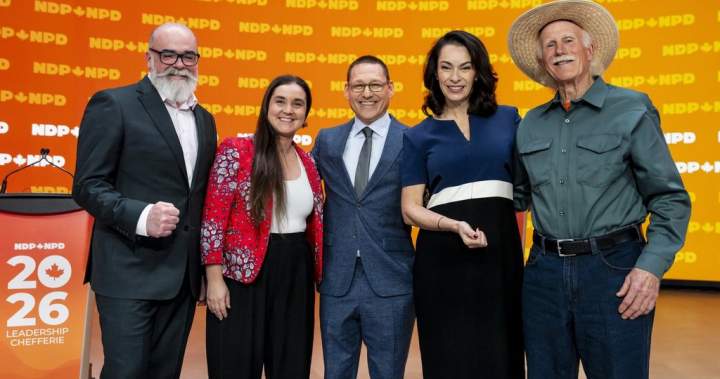
The NDP leadership candidates began the final official debate with a general acknowledgment that they agree on policy, but have different visions for how to achieve their most important goal, rebuilding the party.
At the end of the debate, each candidate was asked whether they were running to rebuild the party or to become prime minister. Four of the five candidates said they were running to rebuild the party, while Ontario organic farmer Tony McQuail was the only candidate who said he was aiming for the Premier’s Office.
In her speech opening the debate in the Vancouver area, Alberta MP Heather McPherson said her party needs someone who knows how to turn the NDP’s policies and values into electoral wins. He says he has a track record of beating the Conservatives in his home province and can build on that nationally.
After the debate, he said the NDP has always been a party that has “big ideas” but to make them happen, you need to elect the people.
“What we really need to do is look across the country and get to the seats where we’re losing support, and I think we can do that,” McPherson said after the debate.
“I think there are a lot of areas across the country where we’ve seen the New Democrats strong, where people actually think they’re voting – they’re voting for something they’re not,” McPherson said after the debate, referring to the Liberal Party’s vote loss in 2025.
He then pointed to areas he considers winnable for the NDP including Vancouver Island, Metro Vancouver and southern Ontario.
Documentary filmmaker Avi Lewis says the same approach as in previous elections won’t work and the NDP needs to come up with big, bold ideas. He said this could be a winning strategy because his campaign has raised the most donations, nearly $780,000 as of Dec. 31, 2025, and has significant member support.
Lewis disputed the assertion that they all agree on what the NDP needs to do, and spoke about his push for government-run options in grocery, telecommunications and banking as a way to address affordability.

Get daily National news
Get the day’s latest news, politics, economics and headlines, delivered to your inbox once a day.
“We’ve raised almost as much money for our campaign as all the other campaigns combined, we’ve signed up new members in 338 out of 343 participants and we’ve held big events attended by hundreds of people across the country. So there’s something exciting about our offer,” Lewis said after the debate.
Longshoremen’s union leader Rob Ashton disputes this, and says society needs a quicker fix to tackle the affordability crisis and building the new Crown service will take too long.
Ashton said in his opening statement that the party needed to return to its working class roots if it was to try and win back the support it lost in the last election from the Conservatives and Liberals. Ashton said, without that support, their idea would have remained just an idea.
He later blasted Lewis for his authorship role in the Leap Manifesto, saying it killed the Alberta NDP’s chances of re-election under former premier Rachel Notley.
“The part I disagree with is not communicating with the provincial NDP, the Alberta NDP, before bringing it up, before discussing it in Alberta,” Ashton said after the debate.
“Because that’s when the incumbent government, the incumbent NDP government has to fight and defend itself.”

Lewis defended the Leap Manifesto, saying it had broad union support and was adopted as a resolution by three-quarters of the NDP as a federal policy resolution at the party’s 2016 convention in Edmonton.
McPherson said the party simply agreed to look at the Leap Manifesto and that gave the province’s conservative leaders, including former Saskatchewan Premier Brad Wall, a stick with which to beat the NDP.


Social worker Tanille Johnston opened the debate by saying she was honored to be the first Indigenous person to be on a federal leadership ballot.
He said Canada needs to achieve a universal basic income to lift people out of poverty, end fossil fuel subsidies and establish good government-to-government relations with indigenous communities.
Johnston said the party and its leaders need to physically go to more places where there are no seats, talk to people and more importantly listen to people’s needs.
“Not going to places where we have great opportunities doesn’t help us. Prince Albert, great opportunities are in Prince Albert, (Sask.) and a lot of people probably don’t see them. Prince Albert has a very high Indigenous population and people always tell me that Indigenous people don’t vote,” Johnston said during the debate.
“I thought ‘have you gone and had a chat with them?’ … No, we haven’t.”
McQuail said Canada needs radical social change to address climate change and the affordability crisis. He said Canada needs to redistribute wealth and shift capitalist and consumer society to a more sustainable system.
“We have to talk about how we not only transform the economy and transition it to renewable energy, but how we redesign it to drastically reduce the amount of energy and resources the economy uses,” McQuail said in the debate.
“Because our economic growth, which has been promoted for the 45 years since I have been involved in politics, is actually becoming a cancer for the planet.”
Yves Engler, a Montreal activist who was not allowed to take part in the race, and a small group of protesters tried to enter the studio during the debate. They banged on the door, shouting, “Let us in!”
Local police arrived at the studio in New Westminster, BC, to remove the protesters.
The debate broadcast was not interrupted by the protests.
Engler vowed to disrupt the election after his candidacy was not approved.
The race will be determined by ranked voting. Voting opens on March 9 and closes on March 28 at 7 p.m. Voters can cast their ballots online, by telephone or by mail.
The next NDP leader will be announced March 29 at the party’s convention in Winnipeg.


Comments are closed, but trackbacks and pingbacks are open.