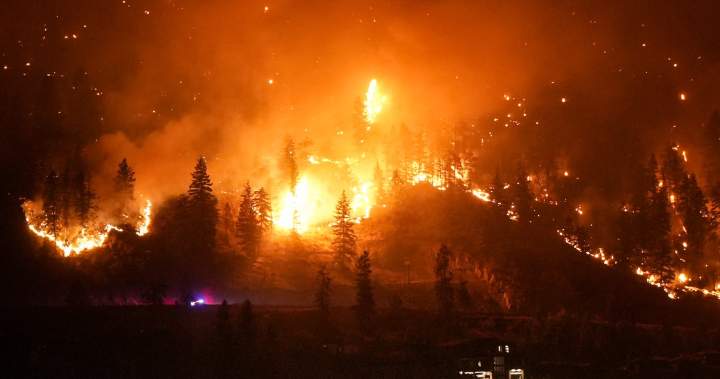
Between December 2019 and December 2025, home insurance premiums in Canada jumped by 45 per cent, with passenger vehicle insurance premiums increasing by 23.9 per cent — and the reason was due to extreme weather claims, according to Statistics Canada.
A study conducted by the agency “examined the impact of rising extreme weather claims costs on Canadian P&C [property and casualty] insurance sector,” found that catastrophe claims reached $8.6 billion in 2024, surpassing the previous record of $6.2 billion in 2016.
The third quarter of 2024 saw many cases of extreme and detrimental weather, with four major events in a 30-day period: the Calgary ice storm ($3 billion), the Jasper wildfires ($1.1 billion), the Quebec floods ($2.7 billion) and the Ontario floods ($990 million).
This resulted in property and casualty insurance companies covering more than $23 billion in disaster claims, according to Statistics Canada.
Each year from 2020 to 2025 ranks among the 10 most expensive years in the history of extreme weather claims, since data tracking began in 1983. Home insurance was found to be “more impacted” by extreme weather claims than auto insurance.
Rising repair costs, vehicle prices and theft contribute to the increase
Even though the percentage increases for auto insurance are lower compared to homeowners insurance, costs and premiums still increase.
“For drivers, car insurance costs have increased due to soaring vehicle prices (especially during the pandemic), rising repair costs, and an increase in car thefts that peaked in 2023,” the study said.

Get the latest national news
Get the latest Canadian news delivered to your inbox so you never miss a trending story.
“Most insurance companies have both auto and homeowner operations and must manage both risks.”
Alberta saw larger premium increases
Alberta recorded the largest cumulative increase in homeowners insurance premiums among all provinces, increasing by 391.6 per cent in the 20-year period from December 2005 to December 2025.
In the most recent five-year period, Alberta (+55.8 per cent), Manitoba (+46.7 per cent), Nova Scotia (+43.1 per cent) and Saskatchewan (+40.9 per cent) all exceeded the national rate of increase of 38.6 per cent.

Statistics Canada cited the disproportionate numbers in Alberta compared to “the increased risk of hail storms, wildfires and convective storms in the province, particularly in and around the Calgary area.”
Forestry and Parks Minister Todd Loewen said May 4 that more than 550 firefighters had been recruited for this year’s wildfire season, and hundreds more were available on request through contracts and mutual aid agreements.
The province also introduced a mutual aid incentive pilot program, offering municipalities up to $125,000 in wildfire response assistance.
“The goal is clear. Reduce urgent financial pressures. Remove obstacles that can delay decision-making and increase the impact of forest fires through a faster and more coordinated response,” explained Loewen at a press conference.
“When the time comes, we want to make sure local governments are picking up their phones rather than checking their budgets,” he added.
96 active forest fires are burning across Canada
According to the Canadian Wildland Fire Information System, there are currently 96 active forest fires burning across Canada, eight of which are classified as out of control.
During Canada’s 2026 wildfire season outlook on May 28, Emergency Preparedness Minister Eleanor Olszewski said that “significant wildfire activity” in BC is expected in July.
“There are so many factors that can change those estimates,” he said. “We have to prepare for the worst.”

An administration official said in a technical briefing that while the risk of wildfires is unlikely to produce a record-breaking year like 2023 or 2025, the federal government still anticipates above-average conditions as the 2026 season progresses.
The 2025 wildfire season is recognized as Canada’s second-worst fire season, with nearly 90,000 square kilometers burned by September 2025 – an area larger than New Brunswick.
“We know clearly that hot and dry weather conditions increase the risk and above normal temperatures are expected across much of Canada over the next three months,” Olszewski said.
Environment Canada released its three-month summer forecast on June 5, warning that there is a high probability of temperatures exceeding average this summer across Canada.
© 2026 Global News, a division of Corus Entertainment Inc.


Comments are closed, but trackbacks and pingbacks are open.